UWB Gestures · 2023–2024 · Radar sensing · Samsung PRISM
Seeing a gesture without a camera.
Turning ultra-wideband radar measurements into recognisable hand gestures, from noisy sensor data to a working inference interface.
A signal becomes a gesture.
Capture static gestures at 10, 25, and 50 cm, including periods where no gesture is being made.
Conceptual pipeline. Selecting a stage does not run radar inference.
Findings from the project report
- Gesture vocabulary
- 5 + 1
Five static gestures, plus a no-gesture class for inactivity.
- Capture distances
- 10–50 cm
Measurements at 10, 25, and 50 centimetres.
- Reported best accuracy
- 96.78%
CNN v3 superclass accuracy in Table 1 of the project report.
Source: arXiv:2310.15036v3. The report uses a random 70:15:15 train/validation/test split; this is not evidence of performance on entirely new users or a deployed consumer device.
Give the radar a vocabulary
The collection covered OK, VICTORY, STOP, PALM, and LIKE at three distances. A no-gesture class gave the system a way to recognise inactivity. The report records 9,360 seconds of data, with 5–12 participants across the gesture groups.
The work before the network
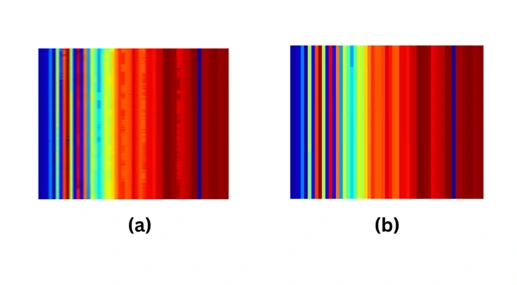
Rolling-median and Z-score processing reduced outliers. Measurements became false-colour images, then were resized while preserving aspect ratio. The before-and-after figure shows this step: the model receives a representation of radar returns, not a photograph of a hand.
Accuracy was only one part
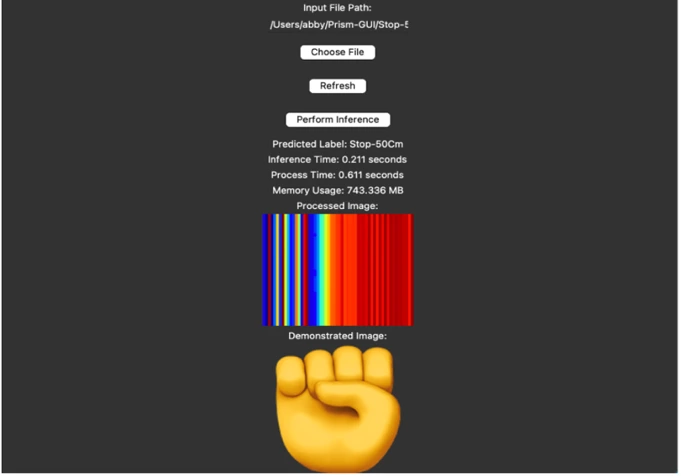
We compared CNN and MobileNet variants, then built a GUI to inspect predictions, processing time, and memory use. The best reported superclass accuracy was 96.78%. Evaluating resource use alongside predictions made the result more useful than an accuracy number alone.