Enhancing Intrusion Detection on IOV's Through Federated Learning
2023 · arXiv · Best Paper — ICRTDA-2023 · Abhishek Sebastian, Pragna R, Sudhakaran G, Renjith P N, Leela Karthikeyan H
Federated intrusion detection for Internet of Vehicles that keeps raw driving data local.
Vehicles share a lot of network signal and almost none of it should leave the edge as raw dumps. This paper proposes a federated learning IDS for IoV on CIC-IDS 2017, with SMOTE for class imbalance, outlier removal, and hyperparameter tuning.
Two virtual edge devices train local models, which contribute to a central ensemble. The evaluation also considers KDD-Cup 99 and UNSW-NB-15. The central model performs slightly below the individual edge models in the reported comparison, making aggregation quality a concrete trade-off.
These are benchmark experiments rather than a live connected-car deployment. Keeping raw training records local reduces centralisation, but model updates can themselves contain information; no formal privacy guarantee is claimed by this portfolio.
Local records. Shared learning.
The study addresses class imbalance with SMOTE, filters outliers, and tunes model hyperparameters.
Benchmark architecture, not a connected fleet. Model sharing is not by itself a formal privacy guarantee.
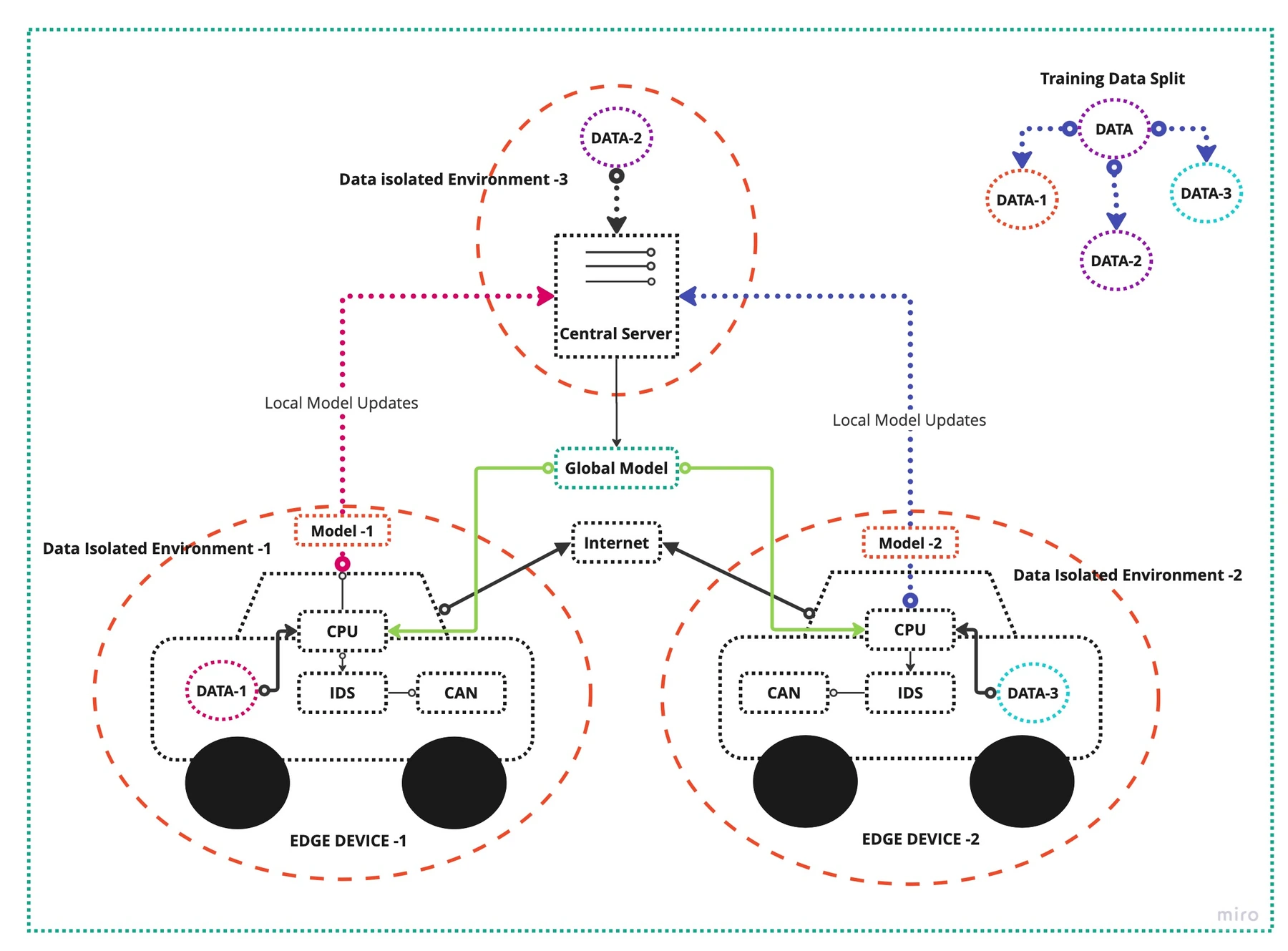
- Federated learning
- IoV
- Cybersecurity